I am Linda and along with my husband Richard and our dog Oreo we enjoy our summers on the UK's canal system

Tuesday, 30 September 2014

Woolhampton (Kennet & Avon Canal) – Monday 29th September

There appeared to be a mix up in our starting time this morning.  We were all ready at 10am but there was no sign of life next door until 11am.
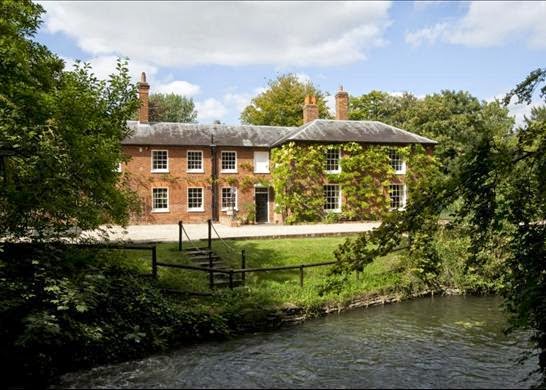
Shenfield Mill from the front (taken from Rightmove) 
Opposite the moorings at Theale is a beautiful old house which is having a lot of work done on it.  Research shows that it used to belong to Kate Bush and was on the market last year for £3.5m!  It looks as if the new people are rebuilding the old mill as well – I shall look forward to coming back this way in the spring and seeing how things have moved on – probably find there is a 6 foot fence round it by then!


Shenfield Mill from the canal
After Sulhamstead Lock there is a great deal of bank work going on with two large C&RT boats but not a person to be seen at 11.30 on a Monday morning!  They are putting those horrid coir sausages down which I know will look nice – eventually.  However I always think they look so horrid and we once got one caught round the prop and had to get RCR out to free it.

Coir sausages 
We stopped at Tyle Mill to use the services and then ascended the lock.  I realised that Autumn is now here as I looked back down the canal.  The leaves are changing colour and the water is covered with fallen ones.  Being on the Thames I hadn’t realised how advanced the season is as you just don’t get the same amount of trees.

Tyle Mill Lock

At Padworth Lock we met a hire boat coming down the lock backwards!  The hire company had suggested that they do this and wind at the bottom to save time.  Great – but these people were novices and winded the boat like a car – a 12 point turn!

At Aldermaston lock Diane and I let the men do the hard work – Richard says that the bottom gates are getting worse and worse.  However C&RT are closing the lock for 4 weeks in January/February so hopefully when we come back this way in the Spring there will be nice new gates!  They are also going to be working on Bulls and Fobney locks during the winter.

Woolhampton Swing Bridge 
The swing bridge and lock at Woolhampton were nice and easy today.  We picked up another boat at the bridge who had already prepared the lock so I operated the swing bridge and all three boats went through.  Daisy Chain had to wait to use the lock but there was very little flow coming out of the Kennet where it joins the canal below the lock so there was no problem.


Woolhampton lock and moorings
The three boats took the last three spaces on the moorings.  Steve said that the other boats that are moored here were there when they came past two weeks ago.  He also said that the wide beam has been here for months.  C&RT – where are you??

The Rowbarge

We went to the Rowbarge for dinner to celebrate Steve’s birthday and lament our last night on the water.  I had a rump steak and it was one of the best I have ever had.  It was a lovely evening though rather sad in a way.

5.93 miles
6 locks

Monday, 29 September 2014

Theale Swing Bridge (Kennet & Avon Canal) – Sunday 28th September

A sad day as we left the lovely River Thames.  I have so enjoyed it, and as I might have already mentioned, we will be back next year to spend most of our summer on it and really explore.  However it was also a happy day as it was Steve’s birthday J

As is the norm we were away at 10am and headed down to Caversham Lock under the nice Caversham Bridge.

 Caversham Bridge
Caversham Lock
Locks have been documented at Caversham since the 15th century, although these were undoubtedly flash weirs. It wasn't until 1777 that the Thames Commissioners decided that they had to spend £1,000 on building a pound lock, the first one using fir wood. In those days the owners charged a toll of two pennies per ton to merchants taking their barges through the lock.  It is recorded that in 1778, a new lock office be built for the keeper. It was a small wooden affair, provided 'for the keeper to receive his money and put in his tools for the necessary opening the pound.'

We pulled over at Tesco to stock up on fresh stuff and then said goodbye to the River Thames for this year :-(

Goodbye River Thames 
Hello Kennet and Avon Canal
At Blake’s Lock the fun began!!  As we approached we could see a boat in the lock and one waiting.  The chap on the one waiting appeared to be single handed so I went up to help.  As he entered the lock I realised he wasn’t single handed – his wife was sitting in the cratch and proceeded to hold a bow rope round a bollard – from the cratch.


Blake’s Lock

Blake's Lock is unique because it is the only one that, while controlled by the Environment Agency, is not on the River Thames. As with most other locks on the River Thames, Blake's was originally a flash lock.  It used to be owned by the then Kennet and Avon Company.  Records show that there was a lock keeper's house here in 1802, but this was demolished to make way for a new building in 1840.  In 1771, the toll at Blake’s Lock was fourpence halfpenny, and in 1821 it was 19 shillings per 140 tonnes.


Down through the Oracle

The traffic lights were on red so I pressed the button and waited.  Two boats came through saying that there was a hire boat behind them (three boats – interesting!)  We waited and waited and then our light turned green – what to do!  When it turned red we went anyway not wanting to miss our turn.  Down through the Oracle with trepidation in case we met the hire boat on a bend but there was no sign of it until we got to County lock waiting where they were – I’m not sure what they were doing!  Steve managed to nose up to the lock gate and drop Diane off but Richard got caught by the current and we were at a rather strange position for going into the lock!  Eventually we came alongside the hire boat and I asked why they hadn’t gone when the light was on green and it was something to do with the lock gate came open so they went back to close it.  Anyway no problem (well I was very annoyed – understatement) and we went into the lock.  A hire boat came down the river and tried to come alongside the lock waiting but the current took them too and I really thought they were going to get stuck on the weir but with me shouting instructions (I’m not sure if the skipper could hear but it made me feel better) they straightened themselves out and pulled the bow into the lock and ended up nose to nose with Daisy Chain!  Still it all adds to excitement – the Thames locks have been lovely but a bit boring!

Someone is the wrong way round!

At Fobney Lock we found our “single hander” in the lock with the ghost crew doing her bit from the cratch.  Diane and I worked them up!  We pulled over for lunch not long after Fobney and then moved on through Sheffield Lock and Theale Swing Bridge and pulled over for the night.  That was enough excitement for one day!


8.66 miles
7 locks

Sunday, 28 September 2014

Thames Promenade, Reading (River Thames) – Saturday 27th September

We were woken up about 6.30am by voices and banging.  Neither of us went to investigate but when we got up later Wallingford riverside was abuzz with people, sculls and pontoons!!  It was the Wallingford Long Distance Sculls race.  I looked it up on the internet and discovered that there were 575 teams registered which were divided up into three races.  Races 1 and 3 were over 4,250 metres and race 2 was over 1,500 metres.  There were so many divisions that I couldn’t even start to list them but basically there were Quads, Coxed Quads, Double Sculls and Single Sculls.  Crews are timed – they don’t race against each other.  As we moved down river the rowers were getting down to the start for the first race and were lining up in numerical order – the highest number we saw was 250.  It much be a logical nightmare to organise all the rowers and, of course, make sure they all start in order!


Wallingford Long Distance Sculls

We took on water at Cleeve Lock which on self service.  Way back in the 1580s a flash lock was recorded at Cleeve, named after a cliff, or clift - a cutting of a channel by water. This weir was converted into an oak pound lock in 1787.  In the 1900s, the lock keeper was a man called John Willey. John fought for his country during the Great War and won the Distinguished Service Medal. Unfortunately, he drowned in the Thames in April 1919, having suffered, according to the coroner, 'a temporary aberration of intellect'!  Apparently
The river island adjoining the weir walkway is owned by Pete Townsend of The Who rock band.

Cleeve Lock

Next was Goring Lock which is one of my favourites.  I always love looking back at the weir and the lovely houses behind it.  The lock itself began life, records tell us, back in the 1500s as a flash weir. It was constructed by the local mill owner to provide him with a head of water to drive the water wheel. A side benefit was that it made the water deep enough for river craft. It became a timber pound lock in 1787, costing, it is said, £1,000 to build.  When Goring Lock was rebuilt by the Thames Conservancy in 1921, it was built with a very obvious difference - it had a pair of middle gates. This was to save water and enable river craft to travel faster through the lock. The middle gates were removed in 1981.

Goring Lock Weir

We stopped at Beale Park for lunch.  Strangely enough neither Richard nor I have ever stopped there before – so a first for us but we will be back!

Whitchurch Lock was on self-service with two boats already in and one waiting to come up.  That must be the busiest we have seen recently.  Whitchurch Lock began life as a flash weir in 1580 and was converted to a wooden pound lock in 1787. The manual beams were removed in 1966 when the lock was converted to electro-hydraulic operation.  The Lock House is the only surviving one of its type - the arched window design is the same as when the house was built in 1829.

Whitchurch Lock

I commented on our way up that Whitchurch Bridge looked as it was almost ready to open and it is now with pedestrians and cars crossing.  The toll is 40p for a car.

Whitchurch Bridge

It was then down the lovely stretch to Mapledurham Lock.  The Lock has been linked through the ages with the nearby corn mill - the only water mill working on the River Thames today. The mill appears in the Domesday Book, so it follows there was a dam or weir here in 1086, one of the earliest recorded on the river.  Mapledurham Lock made history in 1956 when it became the first mechanical lock on the River Thames. It used an early type of electro-mechanical system although it wasn't very successful and was converted to hydraulic operation in the 1974.  Apparently the famous film The Eagle has Landed was filmed in 1976 partly at Mapledurham Mill.

Mapledurham Lock

We moored up at Thames Promenade at Reading again.  We thought it might be busy on a Saturday but there was only one boat and I’m pretty sure that was there last time!  While we were mooring up Muffin managed to fall in!  I told him to go ashore just as Richard pulled the bow ropes in which made the stern go out so suddenly there was a bigger gap than he anticipated and splash!  Richard fished him out while I kept the boat from squashing him – he then went dashing madly around drying himself off!


As we were sitting out on the grass a hot air balloon appeared from behind the trees.  It’s Steve’s tomorrow so I thought it was rather appropriate.

15.27 miles
4 locks

Saturday, 27 September 2014

Wallingford (River Thames) – Friday 26th September

We pulled pins about 10am and set off down river.

Domesday in the 11th century recorded a mill on the River Thames at nearby Sutton Courtenay, where the river originally meandered. However, in those days the lock (probably a flash weir) was difficult to negotiate by boat due to the shallow river - and the tolls were said to be the highest on the Thames, making it unpopular with merchants using the river.  Eventually, in 1809, a new deeper Culham Cut - and a new pound lock - were excavated and both were welcomed by all who used them if only because the tolls were not so high.

Culham Lock

Apparently Culham is a 'shrunken village' - that is, it's much smaller today than its original size. It is a mystery why this happened. Suggestions include the Black Death and poor harvests following wet summers in the 14th century.

Clifton Lock - or Clifton Hampden Lock as it's also known - was first talked about way back in 1793, and discussions continued in 1811. But it wasn't until 1822 that this lock was constructed.  Originally, the River Thames flowed in a loop towards Long Wittenham village but it was decided to dig a new, more direct, cut to by-pass the longer route. So today's lock, a hydraulic pound type operated electrically, looks very much like it did when it was built nearly 200 years ago, but without the heavy oak beams used to operate the lock manually.

Clifton Lock

Apparently St Michael & All Angels Church at Clifton Hampden was originally built on an ancient volcano blow-hole.

Just before Day’s Lock we spotted Still Rockin and No Problem moored up.  We pulled over and had a quick chat before going down to the lock.

Day's Lock

The area around Day's Lock is said to be the most historic place in Oxfordshire. There are many reasons for this: a hilltop fort was built by iron-age man on Castle Hill and when the Romans invaded they built a camp where the nearest town would be founded - Dorchester.  For centuries this has been a religious area. Neolithic man built ritual henges a mile upstream. During the sixth century, St Birinus established the first cathedral in Wessex.  From the lock you can see two hills topped by trees. These are the Sinodun Hills - known usually as the Wittenham Clumps and less respectfully as Mother Dunch's Buttocks. The unfortunate Mother Dunch was the wife of a less-than-popular local medieval squire.

Day's Lock is the main gauging station for measuring the flow of water in the river. It has another claim to fame too - in 1605 King James I instigated the Oxford-Burcot Commission which built the first locks on the Thames in the 1620s. Burcot is a small village near Day's Lock.

Shillingford Court
Before Shillingford is Shillingford Court probably my favourite house on the Thames.  It is only a semi nowadays but I can just imagine it when it was built in the late 19th century. One part of the house with six bedrooms was on the market in 2012 for £1,295,000!

Benson lock was on self-service – I think that’s only the second this year.

Benson Lock

Benson Lock's history goes back into the late 1300s, when a mill and weir were recorded. It wasn't until 1788 that the first timber lock was built and in turn this was converted to a stone lock in 1870. There used to be a ferry operating here, but this stopped running when the weir walkway and lock gates became available to the public.

Wallingford Bridge

We moored up in Wallingford and had a wander up to the town.  There really is very little in the way of shops except for a very good hardware shop and a Waitrose.  We returned to Mary H and sat out on the bank with Steve and Diane until about 6.30pm when the cold really got to us!! 

Our flights to the US have been booked today – only 229 days to go!

Strictly started tonight – yeeeeees!

12.83 miles
4 locks

Friday, 26 September 2014

Abingdon (River Thames) – Thursday 25th September

We didn’t have very far to go today so didn’t pull pins – or maybe that should be unwrap the lines from the bollards – until 11am.

The King’s Arms from Sandford Lock
It was down through Sandford Lock which is the site of one of the first three pound locks built on the Thames in 1630. It was built in stone and was rebuilt in 1795 and 1836. Over the years the lock has undergone many modifications and updates, and little of the original construction remains.  The existing lock, the deepest on the non-tidal Thames, was built alongside an earlier.  In 1875 the nearby Sandford Paper Mill was rebuilt requiring the head water level to be raised by 5 feet. This may explain the need for such a deep lock-chamber.

Abingdon Lock
We stopped at the services above Abingdon Lock before descending down to Abingdon Meadows.  Abingdon Lock's history is as fascinating as it gets. At Swift Ditch there are remains of a lock constructed around 1624 which is the oldest surviving lock chamber in the UK, and possibly Europe.  This ancient lock - now acting as a weir - is near the top of the Swift Ditch, a meandering stream that by-passes the town of Abingdon to the south. You can still see the old brick chamber at the head of the Swift Ditch. 


Abingdon Lock Weir

You may have noticed that I have been writing a lot about the locks on our return trip down the river.  I didn’t want to keep repeating things and found the Visit Thames website which is full of interesting facts.

After mooring up Richard and I wandered up to the lock and then across the weir and into the town – destination Waitrose!  It was a much nicer, though longer, walk than going up through the town but Muffin appreciated it.  Shopping done it was a walk back to Mary H through the town. 

4.98 miles
2 locks

Thursday, 25 September 2014

Sandford Lock (River Thames) – Wednesday 24th September

Steve and Diane have two cats on board – Sooty and Sweep (and no Sooty isn’t black!)  Sooty in particular likes to hunt at night and has been bringing in little presents for his parents.  Every morning we get updated with what the night’s catch was but last night had to be the best – SEVEN mice!!  Steve and Diane must be shattered as Sooty does like to wake them up with his presents!  It is also Steve and Diane’s wedding anniversary – so not a good start to their special day.

Our first lock was King’s Lock.  Kings is a modern version of Kingisweire - kin meaning cattle.  In 1289 a weir and fish traps were recorded on the current site.  It wasn’t until 1928 that the pound lock, which is still in use today, was built to replace a flash lock. 
 
A sad sight at Iffley which according to the Lockie at Sandford
sank in strange and interesting circumstances
Next was Godstow Lock which has the distinction of being the highest hydraulic-operated pound lock on the River Thames.  Godstow is also well known for its nunnery ruins which date back to the 1100s, when Henry II was King of England. Here you will find legends of scandal, notoriety and war. It was in the nunnery that Henry II met his mistress, Rosamund Clifford, who bore him two sons. Later the nunnery became notorious for its 'hospitality' towards the young monks at Oxford.  Henry VIII, during the dissolution of the monasteries, destroyed Godstow Abbey. Later, during the Civil War the village was used by Royalists to defend Godstow Bridge. When the Roundheads attacked, the whole site was burned down.

Someone actually lives on this!
We pulled over just after Osney Bridge at the East Street moorings and went searching for a shop as we both needed bread and milk.  We had to walk right up to the Westgate shopping centre to find Sainsburys – it was only half a mile (according to Google maps but it felt a lot longer!)

East Street moorings
After lunch we set off again through Osney Lock which was built in 1790 by the inmates of Oxford Prison. It cost the mere sum of £750.

Down passed the moorings at Christchurch Meadow where the same boats were moored as had been on our way up.  Apparently between Osney Lock and a point just downstream of Iffley Lock, the Thames also goes by its Roman name, the Isis.

The happy couple

I had booked lock moorings at Sandford Lock so that we could go to the King’s Arms for dinner.  In fact we didn’t use them but moored on the free 24 hour ones above the lock.  We drank champagne on the bank and then went over for an excellent meal at the King’s Arms which is now open again following the recent flooding.


7.54 miles
4 locks

Wednesday, 24 September 2014

Above King’s Lock (River Thames) – Tuesday 23rd September

Another cold and sunny morning – long may they last.

We had had no internet or phone at Bablock Hythe so I was itching to get away – I really needed a fix!

Richard pulled over just before Pinkhill Lock as he wanted to look at Farmoor Reservoir – I think he was rather disappointed though did say that the water level was low.  The reservoir is known for fly-fishing for rainbow and brown trout, dinghy sailing and windsurfing. Oxford Sailing Club and the Oxford and District School Sailing Association are based there.

Pinkhill Lock
Apparently at Pinkhill Lock in 1935, Amy Johnson, the legendary pilot, flew a biplane from here, signing autographs for fans. She charged half a crown (two shillings and sixpence in old money) a time!
 
Swinford Toll Bridge
We went under Swinford Toll Bridge which was built in 1769 during the days of stage coaches, highwaymen and turnpikes and is described as the finest of the many bridges over the Thames with its Georgian architecture.

The road over Swinford Bridge takes you into Eynsham which is said to be one of the oldest villages in Britain. It is mentioned in the Anglo-Saxon Chronicle in 571AD when Cuthwolf fought the Britons at Bedcanford and captured four villages, Limbury, Aylesbury, Benson, and Eynsham.

Aerial photo of Eynsham Lock
Eynsham lock was used by merchants taking salt from Droitwich and stone from Taynton.

We pulled over for lunch at the same mooring place above King’s Lock that we used on our way upstream and didn’t move again!  We were going to go to Godstow but it is very close to the A34 and as it is nice and quiet here we decided to stay put.


I spent the afternoon planning a trip to East Sussex in our caravan for the end of October.  I still haven’t finished the trip to the US – we are such jet setters!!

5.95 miles
2 locks  

Tuesday, 23 September 2014

Bablock Hythe (River Thames) – Monday 22nd September

A lovely bright and sunny morning though it was cold – we put the heating on and out came the winter duvet!

 Looking to Radcot Bidge
Our mooring
We had a late start and cruised to The Trout at Tadpole Bridge where we decided to frequent the pub for lunch.  The garden was very nice but the menu was rather sparse and very expensive - £9.95 for a roast beef sandwich!  We ended up with four bowls of chips and two of pork scratchings which were lovely.  I had put my washing on the whirligig before the leaving the boat and all bar two tee-shirts were dry!

The Trout at Tadpole Bridge
There are a couple of tight bends before Shifford Lock and sadly we lost one of my cauldron planters as we went under a tree.  It went over the side but before Richard could get the boat hook I watched it swirl and disappear under the water.  It rather spooked me as if it had been a baby or a cat I don’t think it would have stood a chance though I guess someone would have dived in to rescue one of those – hm why didn’t Richard dive in to get my cauldron?

Newbridge

We passed Newbridge which, in fact, is the second oldest on the river dating back from the 13th century - only Radcot Bridge is older – and is Grade II listed.  Newbridge and Radcot were built by monks on the orders of King John in order to improve communications between the wool towns in the south of England, and the Cotswold farms.  The River Windrush joins the Thames at Newbridge after its journey, via Burford and Witney, from its source near Bourton-on-the-Water

The lock house at Rushey Lock was in the past a guest house, providing a peaceful retreat for famous names such as Douglas Fairbanks and Errol Flynn.

Northmoor Lock

At Northmoor Lock I was intrigued as to why the Lockie opened one paddle fully but the other one only half – when I asked him I expected some technical explanation but was told that it’s the end of the season and he fancied some variety!!!  Still that brightened up my day at bit!  Northmoor Lock is one of the latest to be built along the river, constructed in 1896 and replacing the ancient Hart's and Ark flash weirs.

Bablock Hythe and The Ferryman
We were headed for Bablock Hythe and I really couldn’t wait for us to get there – it had been a long and twisty journey.  At Bablock is the Ferryman pub - a ferry service has been operating on and off by the pub for 1000 years. During the summer months the landlord of the Ferryman keeps the tradition alive with a small passenger boat.


13.57 miles
4 locks